
Townsville Lawyers providing trusted legal advice
across North Queensland for over 130 years.

Compensation Law
Compensation Law
Includes personal compensation claims, superannuation claims and professional negligence claims.
Explore
Family Law
Family Law
Includes separation, divorce, property settlements, children and domestic violence.
Explore
Wills & Estates
Wills & Estates
Includes Estate Administration, Estate Litigation and Estate Planning.
Explore
Property, Development & Leasing Law
Property, Development & Leasing Law
Includes property, body corporate, land subdivisions, unit developments, mortgages, securities, rural and town planning matters.
Explore
Criminal Law
Criminal Law
Our criminal lawyers will assist with traffic offences, domestic violence and white-collar crimes.
Explore
Conveyancing
Conveyancing
Includes residential sales and purchases
Explore
Business Services & Employment Law
Business Services & Employment Law
Business and commercial law including business sales and acquisitions, leasing, employment and industrial relations law, maritime law, PPSA matters, company incorporations and trust establishments.
Explore
Commercial Litigation
Commercial Litigation
Includes debt recovery, business disputes, building and construction, insolvency, environmental offences and town planning appeals.
Explore
Leading Lawyers Townsville
Sometimes, all you need is a fresh perspective. Connolly Suthers are North Queensland’s most experienced and qualified law firm. Established in 1895 with a foundation of leading Townsville lawyers, Connolly Suthers has since become one of North Queensland’s largest, most diverse, and dynamic firms.
Employing a range of expert Queensland lawyers who offer specialist legal advice, Connolly Suthers comprises a team of individual talents working under collective energy. Originating from Townsville Connolly Suthers deliver Queensland’s highest standards of legal help, advice, and services.
We work under the belief that strong reputations don't go unnoticed, and this is why our firm has continued to successfully service the legal needs of North Queenslanders for over 130 years. Work with a law firm that understands you and prioritises your needs – work with Connolly Suthers.
Read MoreWhat Our Clients Are Saying
Read AllOur Legal Blogs
Read All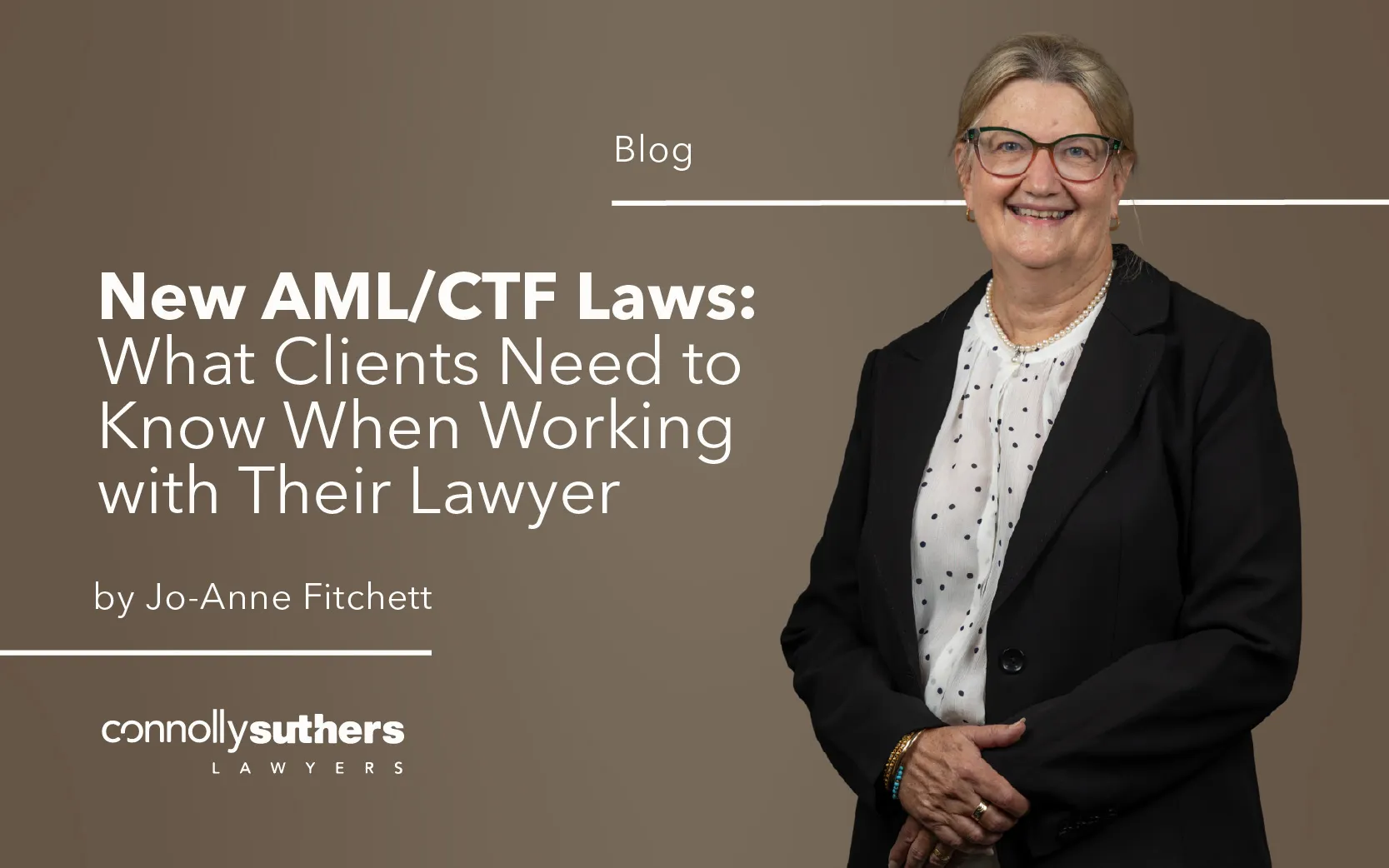
New AML/CTF Laws: What Clients Need to Know When Working with Their Lawyer
From 1 July 2026, significant changes to Australia's Anti-Money Laundering and Counter-Terrorism Financing (AML/CTF) laws have come into effect. These reforms expand Australia's anti-money laundering framework to include a range of professional services, including certain legal services provided by law firms. While many clients may notice additional identity verification requests or be asked for more information at the beginning of a matter, these changes are part of new legal obligations designed to protect Australia's financial system and help prevent money laundering, terrorism financing and other serious financial crime. Why have these laws changed? For many years, banks and other financial institutions have been required to comply with Australia's AML/CTF legislation. The latest reforms extend similar obligations to professionals involved in higher-risk transactions, including lawyers, conveyancers, accountants and real estate professionals when providing certain designated services. The purpose is to make it more difficult for criminals to misuse legitimate businesses and professional advisers to disguise or move the proceeds of crime. What does this mean for our clients? If Connolly Suthers is providing a legal service that falls within the new AML/CTF framework, you may be asked to complete identity verification before we can begin certain work on your matter. Depending on the circumstances, we may ask you to provide: Your full legal name Date of birth Residential address Government-issued identification (such as a passport or driver's licence) Information relating to companies, trusts or SMSFs involved in the transaction Details of directors, trustees, beneficial owners or other individuals connected with an entity In some matters, we may also be required to obtain additional information about the source of funds or source of wealth used in a transaction. These requirements are determined by law and will depend on the type of legal service being provided. Why are we asking for more information? Many clients have never previously needed to provide this level of information to their lawyer. The new legislation requires law firms providing designated services to carry out Customer Due Diligence (CDD). This involves understanding who our clients are, verifying their identity and, where appropriate, understanding who ultimately owns or controls companies, trusts or other entities involved in a transaction. These obligations apply across the legal profession and are not unique to Connolly Suthers. Will this delay my matter? It doesn't have to. The quickest way to avoid delays is to complete any identity verification requests as soon as possible. For many matters, we are unable to provide certain legal services until the required AML/CTF checks have been completed. Responding promptly to requests for information helps ensure your transaction can proceed as efficiently as possible. What if I receive an email from InfoTrack? As part of our onboarding process, some clients will receive an email from InfoTrack, our trusted third-party identity verification provider. The email will clearly identify Connolly Suthers and guide you through the required verification process. Completing this process online is generally the fastest and simplest way to satisfy the new legal requirements. Is my personal information secure? Yes. Any personal information collected for AML/CTF purposes is handled in accordance with Australian privacy laws and is used solely to meet our legal and regulatory obligations. Identity verification completed under the AML/CTF legislation is not a credit check and will not affect your credit score. We're here to help We understand these new requirements may be unfamiliar and, in some cases, involve additional documentation that clients have not previously been asked to provide. Our team is committed to making the process as straightforward as possible while ensuring we meet our legal obligations under the new AML/CTF regime. If you have any questions about the information requested or why it is required, please contact the Connolly Suthers team on (07) 4771 5664.

Health Complaints in Queensland: Your Right to an Investigation
Every Queenslander has the right to make a complaint about the conduct of a health service provider. If you believe you have received unacceptable medical treatment, you are entitled to raise your concerns and have them independently considered. Below is a brief overview of how you can make a health complaint in Queensland, and why doing so may be worthwhile. Who can you complain about? Anyone can make a complaint about a health service or health practitioner. This includes: Public and private hospitals Public health services Registered health practitioners such as doctors, nurses, dentists, chiropractors and physiotherapists Unregistered health practitioners and other health service providers Raise your concerns directly In many cases, the quickest and most effective way to resolve a concern is to speak directly with the hospital, clinic or health professional involved. Be direct: Speaking with your treating doctor, nurse unit manager or another appropriate staff member may resolve the issue without the need for a formal complaint. Be prompt: Raise your concerns as soon as possible. Delays can make it more difficult to investigate what occurred or achieve a satisfactory outcome. Be clear: Explain what happened, including the relevant dates and events, and outline what outcome you are seeking. Sometimes an explanation, apology, corrective treatment or change of treating practitioner is all that is required. Making a formal complaint If you do not feel comfortable raising your concerns directly, or you are dissatisfied with the response you receive, you may make a formal complaint to the Office of the Health Ombudsman. Complaints can be lodged by telephone, in writing or through the Ombudsman's website. The Office of the Health Ombudsman is an independent body responsible for receiving and investigating health complaints in Queensland. Depending on the circumstances, it may: Facilitate or mediate a resolution; Refer the complaint to another organisation, such as the police or a professional registration body; Investigate the complaint; or Take immediate action where necessary to protect public health and safety. Why are complaints important? Making a complaint can help improve healthcare for everyone. Complaints provide health service providers with an opportunity to identify problems, improve systems and reduce the risk of similar issues occurring in the future. In some cases, your complaint may also lead to an explanation or apology that helps provide closure. Is there a time limit to make a complaint? Generally, health complaints should be made within two years of the events giving rise to the complaint, or within two years of becoming aware of those events. While the Office of the Health Ombudsman may still consider complaints lodged outside this period in some circumstances, making a complaint as soon as possible will usually assist with the investigation. Can I claim compensation? Possibly. It is important to understand that the Office of the Health Ombudsman does not determine whether you are entitled to financial compensation. If you believe you have suffered injury or loss because of negligent medical treatment, you should seek independent legal advice about your rights. A successful medical negligence claim may allow you to recover compensation for losses such as medical expenses, lost income, future care needs and other damages, depending on your individual circumstances. If you would like advice about a potential medical negligence claim in Queensland, please contact the medical negligence team at Connolly Suthers for an obligation-free assessment of your circumstances. Contact the Compensation Law team at Connolly Suthers on (07) 4771 5664.

What Do the New Testamentary Trust Rules Mean for Your Family?
“So my will sets up a Testamentary Discretionary Trust on my death… what do the Government’s recent announcements mean for my family?” This is a question we are now increasingly being asked. Testamentary discretionary trusts (TDTs) have long been considered a gold?standard estate planning tool—providing flexibility, asset protection, and significant tax advantages for families after death. The Federal Government’s 2026–27 Budget initially proposed a major reform: a 30% minimum tax on discretionary trust income from 1 July 2028. That proposal raised serious concerns about the future of testamentary trusts. However, following strong industry feedback, the Government made an important announcement on 18 June 2026: Income from testamentary discretionary trusts will be excluded from the new 30% minimum tax—subject to important conditions. So where does that leave things? What Has Actually Changed? The big shift (in plain English) Originally, the proposal meant: All discretionary trusts (including TDTs) would effectively face a minimum 30% tax Now, following the 18 June announcement: TDTs are carved out of that minimum tax, at least in principle However, the carve out is not absolute. The Government has introduced new conditions that fundamentally reshape how testamentary trusts will operate. How Testamentary Trusts Work (Now vs. Future) Current position A typical TDT currently: Distributes income to beneficiaries Beneficiaries pay tax at their own marginal rates Allows flexible income splitting (including to minors) Position after 1 July 2028 (based on current announcement) For qualifying testamentary trusts: No 30% minimum tax applies Existing flow through taxation can continue But only if certain conditions are met. The Fine Print - Critical New Limitations “Genuine testamentary purpose” requirement The exemption only applies where the trust is established for “genuine testamentary purposes” What this means: The Government is targeting artificial or tax driven structures It creates a new integrity rule In practice: Standard will-based TDTs should qualify; But more complex or “recycled” structures may not. This introduces a new area of uncertainty and potential ATO scrutiny. Only applies to estate-derived assets The exemption is limited to income from assets of the deceased estate. Why this matters: If additional assets are later introduced into the trust, those assets may not qualify for the exemption Trustees may need to track and distinguish estate vs non-estate assets This creates real practical complexity in administration. New restrictions from 1 July 2028 For TDTs established after 1 July 2028 the concession will apply only if the trust benefits individuals and tax-exempt entities. Likely impact: Reduced use of corporate beneficiaries (“bucket companies”); Less flexibility in income streaming strategies. So What Does That Mean in Practice? If your will already includes a testamentary trust This is generally good news. The feared 30% tax does not broadly apply; Your trust is likely to remain effective; But: Future administration must consider: - Asset tracing - Integrity requirements If you are updating your will now Things are more nuanced. TDTs are still worth including; But drafting should now consider: - Ensuring a clear testamentary purpose; - How assets will be managed and possibly quarantined; - Future flexibility constraints; A “standard” precedent may no longer be sufficient. What about children and minors? One of the major advantages of TDTs remains: Minors can still access adult marginal tax rates (subject to existing rules) Because: The 30% minimum tax does not apply (for qualifying trusts) This means one of the key tax benefits of TDTs is largely preserved. Will testamentary trusts still be worth it? Yes - very much so. Even aside from tax TDTs still provide: Asset protection (bankruptcy, family law, creditors) Control and flexibility Intergenerational wealth planning The recent announcement confirms: The Government is regulating, not abolishing, testamentary trusts. What Has Not Changed It is critical to understand: The 30% minimum tax still applies to other discretionary trusts; The TDT carve-out: - Is not yet law; - Will depend on final legislation. There is still legislative risk and detail to come. Key Takeaways for Clients If your will includes (or is intended to include) a testamentary discretionary trust: Testamentary trusts are still very much alive The Government has confirmed their continued role in estate planning. But they will be more regulated New rules around: Purpose Asset source Beneficiary classes Will shape how they operate. Existing and future trusts need careful structuring Particularly: How assets flow into and within the trust; How flexibility is maintained under new constraints. Now is still the right time to review your will Even though the outcome is more favourable than first proposed: The rules have changed; Your estate plan should reflect this. Don’t rush unnecessary changes The announcement is: Policy only; Subject to refinement. Premature restructuring could create unintended consequences. Final Word The Government’s original proposal suggested a fundamental shift away from the traditional advantages of testamentary trusts. The 18 June 2026 announcement significantly softens that position. Testamentary discretionary trusts remain a core and effective estate planning tool—but they are moving into a more structured and regulated environment. Between now and 1 July 2028, there is a valuable opportunity to: Properly consider the proposals when the become law; Review existing wills; Refine drafting; Ensure your estate plan continues to deliver the outcomes your family expects. If you would like advice on how these proposed changes may affect your will or estate planning strategy, please contact us on (07) 4771 5664.

The Connolly Suthers Difference
At Connolly Suthers, we feel privileged to be entrusted with our client's legal affairs, helping them navigate what is often some of the most challenging times of their lives. Our diverse, talented team has considerable expertise in multiple aspects of law and channel this experience to make a substantial, positive difference in the lives of locals.
We believe that your lawyer should have a significant understanding of how Townsville operates and its underlying cultural systems to provide the most genuine, useful legal advice possible. That’s why we frequently employ experienced legal professionals locally from within North Queensland, possessing a proud history of employing law graduates from James Cook University. Not only does this allow us to give back to the local community, but it only boosts our ability to deliver the most relevant and beneficial legal advice possible.
Our genuine care for the wellbeing of our clients and attention to detail in every case is what sets us apart from other law firms in Queensland. From criminal law to personal injury law, family disputes, property settlements, child custody, and traffic offences, we'll be in your corner, every step of the legal process. If you’re looking for legal support in Townsville, we’re here to make a positive difference in as many lives as possible. Call Connolly Suthers on 07 4771 5664 to get help today.
Read More
If you have an ongoing case with another firm and you are unhappy with how things are progressing, you might want to consider switching to the local lawyers at Connolly Suthers.
Find out what Connolly Suthers can do for you
Schedule A ConsultationNo Win
No Fee
You can have the best legal representation you deserve without the worry of paying legal costs in the event you lose your case*


Providing a stress-free, 'to-your-door' conveyancing service any day, any time that suits you
Learn MoreFrequently Asked Questions
What legal services do Connolly Suthers offer?
We operate across a range of legal matters including compensation, family, wills & estates, property, conveyancing, business, dispute resolution and criminal law; helping a variety of clients across Queensland to navigate the legal system.
It’s highly likely that you’ll need the services of a lawyer at least once in your lifetime. When you turn to Connolly Suthers for legal assistance, you can be confident that you’ll receive quality legal advice with a personal touch, regardless of which service you require. Our criminal lawyers, family lawyers, and compensation solicitors are here to help with the most common types of legal problems faced in these areas of concern.
Whether you're facing criminal offences, are dealing with a family law matter, looking to file compensation claims, have traffic offences, a domestic violence order, class actions, or just require an experienced team to assure a successful legal outcome, we can provide specialised advice for a wide range of concerns and legal issues.
Whatever type of legal assistance you need, we’re sure to be able to help. At Connolly Suthers, we have considerable experience and knowledge in all aspects of compensation law, family law, wills and estates, property law, criminal law, conveyancing, business services and dispute resolution.
We have Queensland Law Society Accredited Specialists in Property Law, Succession Law, Family law and Personal Injuries Litigation. Combining extensively trained and experienced legal practitioners with state-of-the-art communications and technology, Connolly Suthers delivers an unrivalled level of legal service in the Northern Queensland region. Get in touch with our team today - we're here to provide legal advice for a wide range of legal matters.
Do you offer No-Win, No-Fee?
Yes we offer no-win, no-fee services because we believe that nobody should be denied justice as a result of limited finances. We offer no-win, no-fee services in a range of matters including:
- Traffic accidents
- Workplace accidents
- Public liability accidents
- Medical negligence claims
- Life insurance claims
- Superannuation claims
- Certain commercial disputes
With Connolly Suthers Townsville Lawyers, you get the legal representation that you deserve without the worry of paying legal costs in the event that you lose your case. Our compassionate, friendly team understand the value of excellent service when facing a legal problem and a difficult time. Work with the solicitors that understand you and prioritise your needs – work with Connolly Suthers.
How much does representation with Connolly Suthers cost?
All Connolly Suthers clients receive the absolute highest level of quality legal representation and advice available in the region. Generally the cost of our legal services will vary based on the time required for our legal team to work on your case and the extent of the case as a whole, unless it is one of our fixed-fee services.
Regardless, we believe that nobody should be denied justice as a result of limited finances and that’s why we offer no-win, no-fee services in a range of matters including:
- Traffic accidents
- Workplace accidents
- Public liability accidents
- Medical negligence claims
- Life insurance claims
- Superannuation claims
- Certain commercial disputes
With Connolly Suthers Townsville Lawyers, you get the legal representation that you deserve without the worry of paying legal costs in the event that you lose your case. Work with the lawyers that understand you and prioritise your needs – Connolly Suthers.
How do you charge? Will I need to pay upfront? What are your prices like?
Most legal services are charged in accordance with a costs agreement which is provided to you at the commencement of the matter. Usually this must be signed and returned before any work is completed. This includes work done in most areas such as family law, personal injury, large commercial and leasing work, criminal law and estate administration. From your first phone call, your family lawyer, criminal lawyer, personal injury or estate solicitors can walk you through these fees work.
There are fixed price services available for basic conveyancing, wills and enduring powers of attorney. No nasty surprises - just a team who are committed to the best outcome. Please contact our office for more information about these services.
Do you offer payment plans?
Generally, no. However, you should feel free to discuss your financial situation with the solicitor involved with your case, at your initial appointment at Connolly Suthers. We understand that moving through the legal system can get expensive - from your first phone call, our compassionate team will openly discuss fees and work in your best interests, in a timely manner, to achieve a positive outcome.
Do you certify documents? Do you have JPs available?
We usually only certify documents for clients of Connolly Suthers or in the course of matters in which we are involved. If you are looking to find a JP you can search for one here.
Do you hold relatives' documents in safe custody? What can you hold in safe custody?
For client's of Connolly Suthers we offer the service of storing in our safe custody original Wills, Enduring Powers of Attorney, Certificates of Title, etc.
How are you involved with the Townsville Community?
The partners and staff of Connolly Suthers have long-standing ties throughout the local community. Over a large number of years we have supported various clubs and sporting teams in Townsville and in the Burdekin. We are regular supporters of Ronald McDonald House and the Vinnies foundation.
Find out more about our contributions to the local community here.
How do I contact Connolly Suthers?
You can call our Townsville QLD office on 07 4771 5664 during business hours.
Alternatively, submit an email enquiry to law@cosu.com.au and the Connolly Suthers team will endeavour to respond to your enquiry within one business day.
Where are your other offices located?
Our offices are located at 416 Flinders Street, Townsville and 180 Queen Street, Ayr.
We visit Cairns, Brisbane and Mount Isa as well as other regions throughout North Queensland by appointment.